More Agents, More Samples, or More Thinking?
Untangling inter-agent coordination, independent ensembling, and test-time compute in multi-agent LLMs across 9 primary studies, 516 unique configurations, and 834 baseline contrasts.
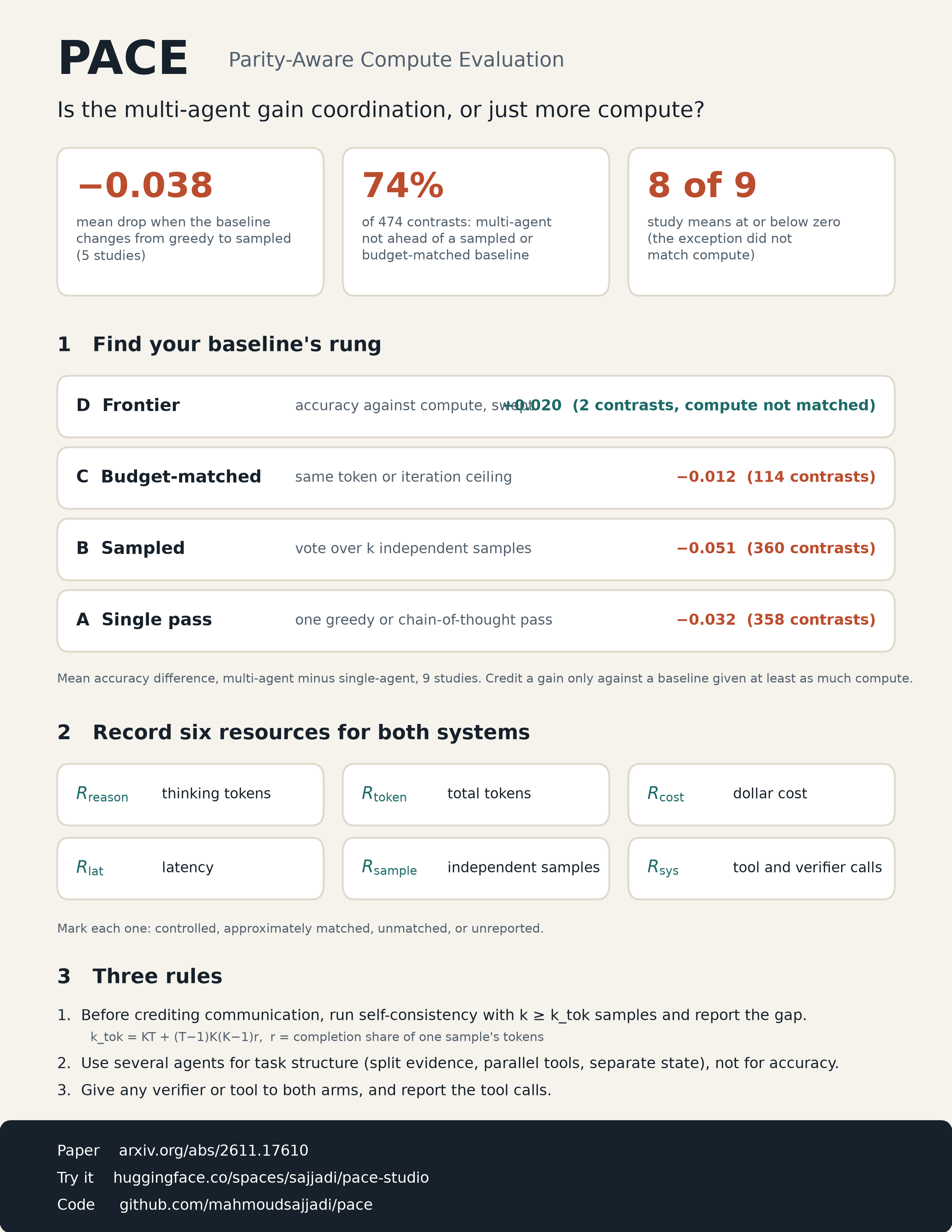
−0.042
Mean accuracy difference across 474 Category B/C contrasts (8 studies; exploratory REML log odds β̂ = −0.195, CR2 95% CI [−0.323, −0.067]).
74%
Of Category B/C contrasts (352 / 474) where multi-agent systems fail to beat sampled or budget-matched single-agent baselines.
−0.038
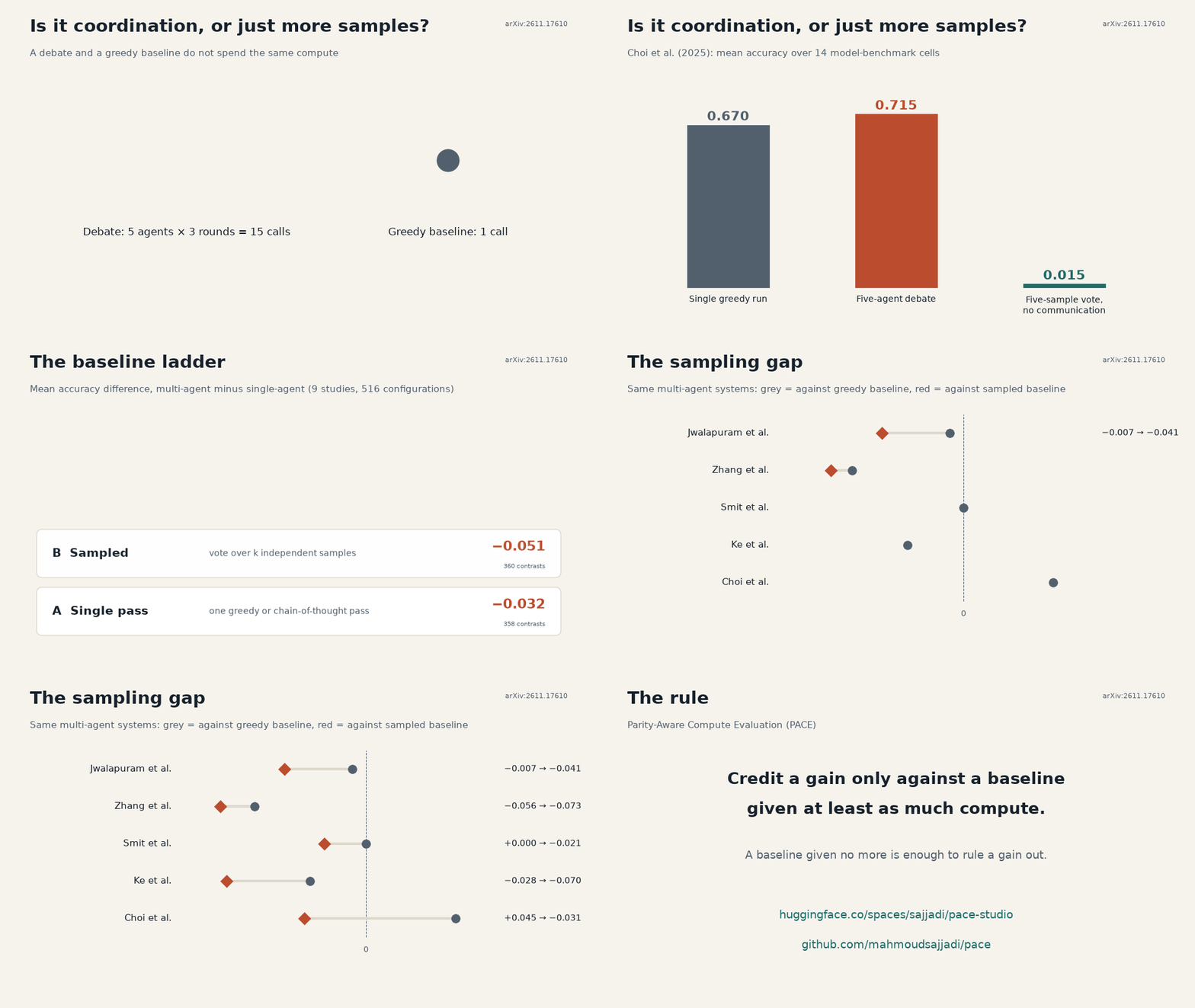
Mean Sampling Gap (Δgap) across 5 dual-baseline studies (318 pairs, 72 unique cells; 64/72 negative) when switching from greedy to sampled baselines.
8 of 9
Study means at or below zero against sampled/matched baselines (sole exception: Wunderlich et al. at +0.020 on Pareto fronts, per-item compute not matched).
60-Second Visual Summary
Why comparing a 5-agent, 3-round debate (15 model calls) against 1 greedy pass confounds communication with sample multiplicity.
1-Command Audit & Studio
Audit AutoGen, LangGraph, CrewAI, Inspect AI, or JSONL traces locally:
pip install pace-eval
pace studio
pace audit run_trace.jsonl
pace dynamics debate_log.jsonl --null null.jsonl
Interactive Four-Rung Baseline Ladder
Click any rung to inspect its empirical performance across the 9-study corpus and the directional feasibility rule required for valid inference.
Token-Equated Pool Sizer (ktok formula, Section 3)
Compute the single-agent sample count ktok matching a K-agent, T-round debate run before claiming coordination gains.
Reviewer & Author Quick-Copy
Drop-in verification block for peer review or experimental setup sections:
PACE Baseline Parity Request (arXiv:2611.17610):
1. Baseline rung: State the strongest single-agent Category [A/B/C/D] (policy and k).
2. Resource vector R: Verify [R_reason, R_token, R_cost, R_lat, R_sample, R_sys] on both arms.
3. Feasibility direction: A positive claim requires baseline resource >= MAS; a null requires <=.
4. Frontier gap & controls: Require the frontier-gap 95% CI and the Route I/II/III controls.